

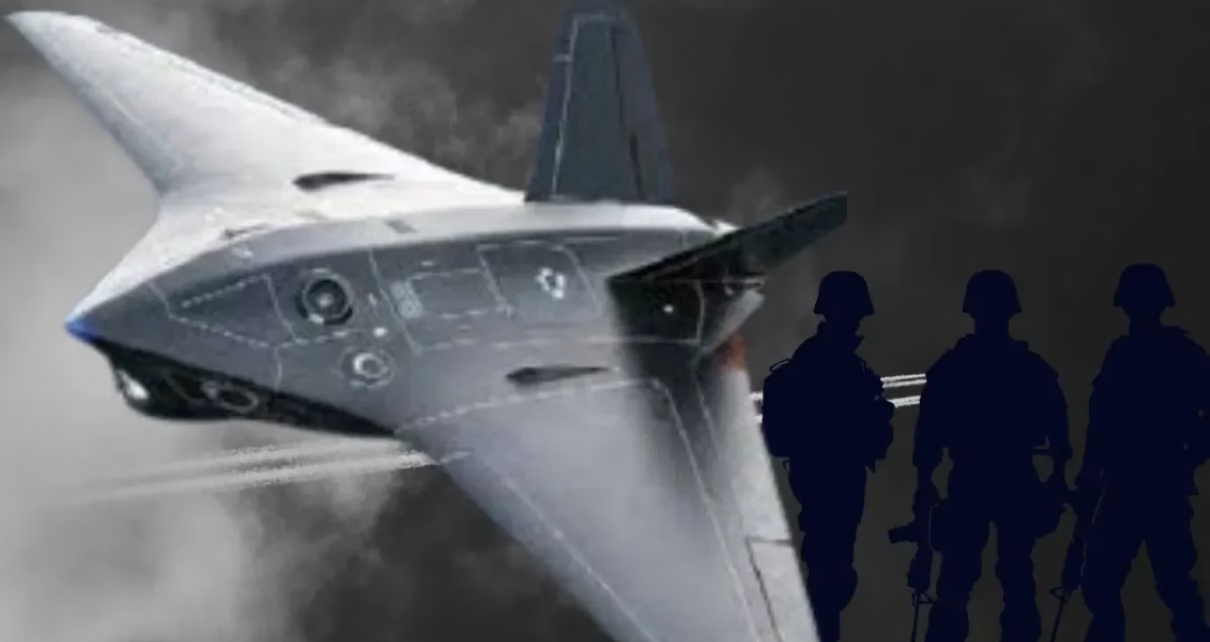
India’s First Dual Stealth Drone to Feature Revolutionary ‘RAMA’ Technology – Know How It Redefines Warfare
Permalink: india-dual-stealth-drone-rama-technology
Meta Description: India is developing its first dual stealth drone equipped with ‘RAMA’ – Radar Absorption and Multispectral Adaptation – a breakthrough technology that can dodge enemy radar and infrared systems with up to 97% accuracy.
Focus Keywords: India stealth drone, RAMA technology, dual stealth UAV, Indian military technology, Veera Dynamics drone
Introduction: India’s Technological Leap in Warfare
In the wake of Operation Sindoor, which showcased India’s growing air defense capabilities to the world, the country is now on the verge of a groundbreaking achievement—its first indigenously built dual stealth drone. This drone isn’t just another UAV; it’s a symbol of India’s self-reliance in defense innovation. What sets it apart is the revolutionary RAMA technology – a nanotechnology-based stealth coating capable of deceiving both radar and infrared detection systems. This innovation could redefine aerial warfare for India’s armed forces.
What is RAMA Technology?
RAMA stands for Radar Absorption and Multispectral Adaptation, a futuristic stealth solution developed by Indian startups Veera Dynamics and Binford Research Labs, in collaboration with the Ministry of Defence. This coating is engineered using indigenous nanotechnology and has shown the ability to absorb radar signals and convert them into heat energy while also minimizing thermal signatures.
The RAMA stealth coating boasts an effectiveness rate of up to 97% in evading enemy detection. This means that drones equipped with this tech can fly through hostile airspace with a significantly reduced chance of being intercepted or shot down.
Why Is This Drone Special?
Unlike traditional drones, India’s new dual stealth drone is lightweight yet powerful, weighing approximately 100 kg and capable of carrying a payload of up to 50 kg. But what truly makes it exceptional is its dual evasion capability – it can bypass both radar and infrared detection, a first in India’s drone history.
In conventional scenarios, out of 100 drones sent for a mission, only 25 to 30 might reach the target. However, with RAMA technology, success rates shoot up to 80–85%, making it a highly dependable asset for covert operations, reconnaissance, and strategic strikes.
Veera Dynamics: The Minds Behind the Drone
Sai Teja, the CEO of Veera Dynamics, revealed that the technology is entering its final testing phase, and the drone is expected to be inducted into the Indian Navy by the end of 2025. The innovation aligns with the Indian government’s “Aatmanirbhar Bharat” (Self-Reliant India) initiative and will drastically reduce reliance on foreign military hardware.
Strategic Importance in Modern Warfare
Modern warfare is heavily reliant on electronic surveillance and missile guidance systems. The first thing enemy forces do is detect incoming drones through radar, followed by infrared tracking to launch countermeasures. This new dual stealth drone breaks that chain, making it difficult to detect, lock onto, or intercept. It can loiter longer in the battlefield and deliver payloads with greater precision and safety.
This development significantly boosts India’s capabilities in electronic warfare, cross-border surveillance, and deep-strike operations.
Other Recent Military Successes
Alongside this stealth drone, India also conducted successful test launches of the Prithvi-2 and Agni-1 ballistic missiles from Chandipur Test Range in Odisha.
-
Prithvi-2: A fully indigenous missile with a range of 350 km and capable of carrying a 1,000 kg warhead.
-
Agni-1: A medium-range ballistic missile with a strike range of 700 to 900 km and a 1-ton payload capacity.
These achievements underscore India’s commitment to strengthening its strategic deterrence and expanding its technological frontiers in defense.
Conclusion: A Giant Leap for Indian Defense
The upcoming deployment of India’s first dual stealth drone with RAMA technology marks a paradigm shift in the country’s defense capabilities. With features that rival and possibly surpass global standards, this innovation showcases India’s growing expertise in indigenous defense solutions. Once operational, these drones will not only enhance the Indian Navy’s aerial might but also serve as a testament to India’s technological vision for the future of warfare.
Disclaimer: The information provided in this article is based on publicly available sources and expert interviews. While all facts are carefully researched and presented, actual military capabilities and deployment timelines may vary based on security protocols and testing results. The purpose of this article is informational only.


